20 February:
I'm in the Seoul airport waiting to board for
Kangnung.
After you get off the plane in Seoul, you go through customs and immigration there -- even if your bags
are checked through. Then you go outside and catch the shuttle bus to the Domestic Terminal
(surprisingly painless to do), then get your boarding pass there. They charge a 3,000 Won tax for entry
(about US$3 at the
current exchange rate).
Actually, I think it's for any time you take a domestic flight, because if I was staying in Seoul, they
wouldn't have collected it. I hadn't changed any of my money yet, so they let me pay US$3.
Most everyone in the airport speaks English, and there are signs in English too.
The flight was long, and it was nighttime the whole way. I had a window seat, but didn't get any
use out of it. I was hoping to see Korea as we flew in, but it was dark enough all I saw were city lights,
which looked just like city lights anywhere. Now it's daylight, so I could see Korea as we fly over it --
but I'm in seat C.
It seems funny to have gone from Wednesday night to Friday morning with no
daylight in between. This must be how it feels to live in Alaska.
There are police in the airport looking very scary with nasty-looking rifles slung across their backs.
They also check you over individually with a wand, even after you walk through the buzzer box.
They made me open my fanny pack. And we thought it was bad in the States!
Tea [Margaret is an enthusiastic tea drinker] so far has been rather tasteless, slightly
colored water. I suspect it's barley tea. I'm going to have to get some real tea soon, or face
a serious caffeine withdrawal headache!
21 February:
It's Saturday now. Apparently I was supposed to pick up my bags in Seoul, even though they'd
been checked through to Kangnung. It caused a lot of confusion at the Kangnung airport (tiny place)
when I was supposed to have my bags and didn't. I was met by
Mrs. Lee [the director of
Best Language Institute], and one of the teachers (Christine).
Mrs. Lee handled things with the airport staff, and Christine told me what was going on. I was
pretty impressed with the way they handled it. In the US they would have taken my name and phone
number, and that would have been it. In Kangnung, they apologized profusely, took us right into
the office, and immediately started searching for my luggage on their computer and calling
Seoul about it. They found it, and told me it would come about 2:00 and that they would bring it
to us. Sure enough, the same men brought the luggage here to Mrs. Lee's apartment about 2:15,
with more apologies.
Mrs. Lee is a widow, with a
son
of perhaps 7 or 8. She said she's glad to have me staying here because she gets lonely, and now
she won't be. So I have a feeling I might not get a place of my own [as promised by the school's
contract with Margaret].
I taught my first classes last night -- took over on
Mrs. Kim's classes. I was a total flop, and the
books they use really seem useless. Primarily vocabulary, no sentences at all, and the kids are
obviously used to having everything explained in Korean, which just isn't happening. [There are]
3 teachers, Mrs. Lee and Mrs. Kim. I'm the only foreigner.
I guess I was picturing
Kangnung as sort of a Perugia [Italy, which Margaret visited two summers
ago -ed] with Oriental flair, but it's more like Akron with Korean writing. Really too big to walk all over.
So far I ride to and from work with Mrs. Lee.
I'm really confused about the
names. Mrs. Lee introduced herself as Mrs. Lee and said Mrs. Kim
immediately after, and she refers to Mrs. Kim as Mrs. Lee. In Korea when a woman gets married
she doesn't take her husband's name, so Mrs. Kim is probably Mr. Lee's sister who married Mr. Kim,
and Korean terms would be Mrs. Lee (or actually in Korean Mr. Kim's wife) and probably called
herself Mrs. Kim to Americanize it for me. So if Mrs. Lee is Mr. Lee's sister in law, she's probably
Mr. Kim's sister, so she could be either Mrs. Kim or Mrs. Lee if her husband's name was Lee.
Confused yet?
Tonight is the first full moon of the lunar new year, and there's a festival on the river to celebrate.
Mrs. Lee and I are going. Mrs. Lee says you make wishes on the moon as it rises. She's going to
wish for a boyfriend, and success and health. I'm going to wish to be able to teach well.
I haven't explored at all yet. The
weather
is cold, and though it's not bad during the day, it's freezing at night. We're going to the bank
this afternoon so I can change some money, and maybe we can look around a little then.
Mrs. Lee has a couch and chairs at the kitchen table [western furniture is not universal in Korea - ed],
so it's probably safe to send [my spinning wheel], but hold off a little. I haven't much space for things.
I wish I were getting a place of my own! I guess I'll add that to my list of wishes on the moon tonight.
22 February:
Last night I had my first "Gee, I'm not home" dream, and it was strong enough that I didn't realize that
I wasn't home until I opened my eyes.
Being on the other side of the world has made a day person out of me. I wake up automatically at 7
am, and fall apart at 10 pm.
Gasoline
runs about 1200 won per liter, so I guess about $4 a gallon, and the South Korean
government is concerned about rising oil prices too.
John
turned the TV on the other day, and was flipping through channels, and there was a show with 3
boys standing at urinals, looking down, pointing and talking. This led into a cartoon depiction
of how reproduction works, the sperm fertilizing the egg, pictures of male and female
reproductive organs, and the development of the fetus. This is geared towards pre-school or
elementary school kids and shown on a major network. No wonder South Korea has the lowest
birthrate in Asia.
Well, after making up beautiful lesson plans for my second day of classes, it turns out that we rotate
and get different classes every day. I started my two adult classes last night ... they spoke some
English already.
The food's good, and Mrs. Lee warns me if anything's spicy. [Margaret is relatively unused to hot
foods. -ed] I'm learning to deal with a little pepper here and there. How Mrs. Lee has room for snacks
with all the food at meals, I don't know.
Did I tell you about the apples here? They grow much larger than our apples and taste much better.
Winter fruits are apples, oranges and tangerines. Winter vegetables seem to be
kimchi
and seaweed, plus the greens she grows on the sun porch.
25 February:
It seems like I've been here for a couple of months now, and it's only been one week. This year
might not go by as fast as I thought.
I finally have the name thing straight (I think). Christina and I went out yesterday, and she explained
it to me. Mrs. Lee is actually Mrs. Kim, because her father's name is Kim. Mrs. Kim is actually Mrs.
Lee, because her father's name is Lee. Christina says we just call Mrs. Kim "Boss." "Like a gangster,"
she said.
We had strawberries the other day, the first of the season. Big, red, and sweeter and with more
flavor than most we get at home. Bananas are better at home, though ... I think I'm going to be
totally spoiled by the fruit here ...
We had lunch at a cute little restaurant. You order your tea or whatever you're drinking to come at
the end -- that's dessert. I ordered black tea and was tremendously disappointed to get Lipton. It
was really funny, though. A Lipton tea bag, in a cup and saucer exactly like a set of dishes I have
at home!
Boss of course doesn't go for chocolate, any more than she does for black tea. "No health," she says,
and she only likes healthy things. She goes to the health club. She does speed skating. She
complains that she's too fat -- muscular is more the term I would use. I think she's trying to
fatten me up.
I start a new class next Friday, at the city Prosecutor's office. Boss is very pleased about this -- I
think it's probably prestigious for the school. I'm a little nervous of course. But I'm getting better
at this stuff and I'm sure it'll be fine. And if they like me, they'll help me stay out of trouble. If
they don't like me, I'd better watch my step!
Boss listens to the radio when she's in the kitchen. The news announcers sound just like American
news announcers. Except for the fact that I have no idea what they're talking about, I could be
listening to NPR. They occasionally play a bit of American soft rock, too. The only Korean
music I hear is when Boss sings. She has a very nice voice.
2 March:
They don't use napkins here, or even very much paper towels. It's Kleenex and toilet paper for
everything. When we went to the Chinese restaurant, there was a roll of toilet paper on the table.
When driving at night, they turn off their headlights when they stop (say for a traffic light) and then
turn them on again when they start driving again. They have no fossil fuels themselves, all are
imported ... makes me wonder why they don't go more for solar and wind power. They've got
plenty of sunshine and wind. [Much of Korea's electricity is generated by nuclear plants. -ed]
They don't heat public spaces, like hallways, and many restaurants and the one museum I went to so far
are very cold and just heated with what look like kerosene heaters. Most people keep their coats
on in restaurants. However, when Koreans heat a space, like in the apartment, it's very cozy. They
do have the
ondol
system where the heat runs under the floors. I don't know what the heat source is.
I wandered around downtown today to see if anything was going on for Independence Movement
Day. Apparently there's a big shindig in Seoul, and here people just put out flags, but that's about it.
I asked the kids what they do to celebrate. Play, play computer games, rest, nothing. It's worse
than Labor Day at home -- at least most people get together for it there.
I got a really cute book for Nef [Brandon, her nephew], and even managed to translate most of it myself,
with help from the dictionary. They have Harry Potter books in Korean, too.
6 March:
We all have colds here, which we all came down with on the same day ... I've never seen such
simultaneity of sickness.
Saturday was fun ... we went to
Ojuk-on,
home to one of the great scholars, and now set up pretty much as a shrine to him and his family,
and also the place of the Kangnung Municipal Museum. We also went to the House of 100 Rooms.
It actually has 99 -- the most any non-royal residence could have. There's not that much to look
at right now, but it looks like they might really do up the gardens come summer ... it's not very
fancy, and you don't get to see it all -- the family still lives in part. The part you do get to see is
pretty run down.
After we saw that we headed back to the road, and it turned out that there were some craft shops
along there -- a woodcarver, a metalsmith, and a potter. I got a couple of necklaces at the
woodcarver -- a sheep and a rooster -- and Christina got a whistle made of black bamboo (ojuk).
The woodcarver had a lot of different things -- crosses, Buddhas, etc. -- and for some reason
she had penises in all sizes. I asked Christina if they were for any particular reason, but she
got embarrassed because she had thought they were mushrooms, and never did answer.
My lesson yesterday with John was on numbers, because I was very frustrated that, in spite of
studying the numbers, I could never understand prices people were telling me. Well, it turns out
that they use different words for numbers when it's money than when it's things.
14 March:
Good news -- Boss has a boyfriend. He lives in Seoul, though, so she doesn't get to see him too often.
She says he's kind-hearted. She gets a huge grin on her face when she talks about him. She's hoping
she gets something for White Day from him [White Day is the holiday on which Korean men traditionally
give gifts to their sweethearts - ed], and she said he might come down to Kangnung this
weekend.
Whether it's because she has a boyfriend or just because it's spring, Boss decided to take early
morning walks for exercise, and I went with her today. She says it's not fun alone
("Walk alone - terrible"). Except for the fact that it was 7 in the morning, it was really pretty nice.
But when she says 7, she's not kidding. Knocked on my door at 6:50, and had her coat on and
was waiting for me by the open door at 6:58.
We walked along the river, facing the mountains for the first half, and they looked very nice
with the early morning sun shining on them. They always look sort of blue, and there was less mist
than usual over them, so the ridges stood out clearly and you could see the snow at the peaks.
The river is very low -- that may be normal for this time of year. Along with the usual ducks and
seagulls, I saw what I think is an egret -- very white and pretty. I also saw a magpie, which
Christine says is good luck. I'll have a lot of good luck in Korea; I see magpies everywhere.
We walked past the
Soju
(rice liquor) factory to a public spring, where a lot of people were collecting water. It has 3 or 4
faucets, with a cup chained to each faucet.
Boss does power walking, fast strides and swinging the arms, the whole bit. I like to saunter.
Fortunately, my legs are about twice as long as hers (all right, maybe just half again as long),
so I didn't need to walk so fast, but I was glad for that drink of water when we got to the spring.
18 March:
I had my first major adventure today -- a trip to the Unification Observation Post by myself. At least
it started out by myself.
Step one was to take the bus to Sokcho, which I managed OK. Step 2 was to take the bus from
Sokcho to Taejon (or Daejon). I got on the right bus, but the bus driver had me get out on the
highway outside of town. Not knowing what else to do, I started walking. It was a wonderful day
for a walk, and I figured even if I never made it to where I was aiming for, at least I'd done
something different, and gone out of my comfort zone. It's awfully nice having someone along
who speaks English, but then I tend to let them do everything and don't try anything for myself.
Anyway, after walking for a while, and figuring at that rate I'd never get there before it closed,
it finally occurred to me to take one of the buses that kept passing me by. I showed the bus
driver in the book where I was heading (it's written in English and Korean), and he told me
when to get off -- again in the middle of nowhere. So I headed up the road. Eventually I saw
signs for "Unification Observation Tower Check in Area," and headed there. Showed my book
to the guard and he pointed to a building. The check in windows on the outside of the building
were closed, so I went inside, and there was a table to sign in and buy your ticket.
When I tried to buy a ticket, the lady just waved me over to an area full of Koreans filling out forms.
I hung around for a minute feeling stupid and getting no inspiration as to what to do, so I went back
to the ticket table and asked if I wasn't supposed to fill out a form. The woman was very nice
and very surprised that I was there alone. I guess she had assumed that someone was filling
out my form for me. The she explained that there were no shuttle busses running, and I should
ask someone for a ride.
I bought my ticket, but got no form to fill out, and then went back to waiting around the form-filling-out
area, wondering who looked approachable. Then the lady came and got me, and showed me a man
who had kindly agreed to take me along. We went outside to where he had two friends waiting. I
said hello to them, and one started talking to me. I told him I didn't speak Korean well, and he started
talking in English! About the level of Mrs Kim, but we could communicate. And I had my dictionary
with me ... so we all went together.
Apparently there's only one copy of the paperwork per car. The guards stop you before you get
to Unification Tower, take your paperwork, look in your trunk (I guess for North Korean spies), and
give you a laminated paper thing to put on your dashboard. Then you go to the tower.
It's very pretty there, and they have mounted binoculars where you put in 500 won [about 50 cents]
and look across the DMZ (demilitarized zone) into North Korea. There's also some military stuff
on display, and a huge Buddha and what looks like a Madonna but probably isn't (might be the
Buddhist Goddess of Mercy), and some other sculptures. I would've loved to have taken
some pictures, but there was a nasty sign, so I was afraid to try. It was in English and said something
like "No pictures from military purposes in front of area." Since I wasn't sure what it meant,
I figured I'd better play it safe.
Anyway, after spending half the day getting there, we really didn't stay very long. I would have liked
to have stayed longer, but when you're riding with someone else you go with the flow. Anyway, the
English speaking guy, whose name is Lee, said it's prettiest from May to October, so I'll have to go
back.
Lee asked if I was staying there, and I said I would take the bus back to Kangnung. He insisted
on driving back to Seoul by way of Kangnung, which is about as sensible as going from Cleveland
to Toledo by way of Columbus. Maybe not that bad, because the distance is less, but you get the
idea.
We stopped off in I think it was Taejon and had a cup of tea and dropped off one of the people.
On the ride to Kangnung, Lee was pretty talkative. His friend Pak, who was driving, was pretty quiet,
but would tease Lee about something every now and then, at which Lee would hit him
in the head with my dictionary (I told you it got a lot of use). About midway I got carsick and
had to ask them to pull over ... it was very embarrassing, but they were awfully nice about it.
I got to ride in the front seat after that.
We made it to Kangnung in one piece and I said I would like to take them both out to dinner, but Lee
said Pak wanted to get back to his wife. Lee said he didn't feel the same way -- he and his wife had
recently had a fight. I don't know how serious he was about that. He did joke around a
lot. So I told him when I came to Inchon, where they live, I would take them out. So I got home
safe and sound, much earlier than I expected.
I got an explanation of the wooden penises [which we saw at the craft shop at Ojuk-on]. This came
from Mrs. Kim with Mrs. Lee translating.
Because Kangnung is on the ocean, in times past most of the men were fishermen, and spent most of their time at sea. So the idea sprang up that by keeping one of these carvings around it would bring your
husband safely home to you. But if he died at sea, you could use it for "something else." That's the
story as it was told to me. We all had a good laugh about it.
Mrs. Kim wants me to pay for my food, and this seemed like an opportune time to mention about my
own apartment. Of course Mrs. Kim was afraid that she had done something to offend me, and was
also disappointed because she had hoped for
John
to be exposed to English more. I was glad I had Mrs. Lee translating through it all. I think she
understood better. They said they would start looking and it might take a month or two,
which is fine.
Mrs. Lee, whose husband lives in Seoul, had a dream that he was sleeping with another woman, and
was mad at him for two days. So we've been having a good time teasing her about it. She actually
called him up at work when she woke up and yelled at him!
29 March:
We all went out to dinner the other night after work. It started out that Christina and I were going to go.
Then Mrs. Lee joined in, and then Boss, and Mrs. Lee's older daughter was there (she's about 11),
and John was there, so it made quite a party.
We went to a chicken place in the Kangnung University area, where we had walked last Sunday.
It's very different on a weeknight. Sunday morning was practically deserted, and Tuesday night
was so crowded you could hardly drive through the streets. Students were milling around
everywhere.
We had chicken bul-gi, which is chunks of chicken, chopped cabbage, green onions, and thin slices
(looking like bamboo shoots) of sweet potato. There's a big griddle in the middle of the table, and
the server dumps a whole plate of stuff onto it. There's also a spicy sauce on it, and Mrs.
Lee had her scrape some of it off for me.
Once the food is dumped [on the griddle], it's up to us to turn on the griddle and stir the food
until it's cooked. Then you either eat the food straight, or wrap it in lettuce leaves and eat it.
There's extra hot sauce too, if you want it. John likes to just dip lettuce leaves into hot
sauce and eat that.
The food was very good, and not impossibly hot, although it was pretty spicy. Mrs Lee had the
waitress bring some water because she figured I'd need it, and she was right. Rice isn't served
with the chicken bul-gi, but is fried on the griddle with bean sprouts and kimchi afterwards.
I'm doing laundry today. No dryer here -- everybody just hangs clothes out to dry, either outside if
they have a yard, or on the sun porch if it's an apartment.
Mrs. Kim left the bathroom door open while she washed her face last night. There's a sink in the
bathroom, a little lower than what I'm used to, but she filled a plastic pan with water on the floor
and squatted in front of it to wash her face. I didn't see for sure, but I think she leaned
forward and dunked her whole face into it.
When [Koreans] squat, they keep their feet flat on the floor. I tried, but I can't do it. My muscles
and tendons don't stretch in that direction. Try it yourself and see how you do. [Just fine,
thanks. - ed]
30 March:
Last night my beginning adult class and half of my advanced adult class and I all went out to dinner
after class. We had Annie, Richard, Tom, Mike, TJ and Mrs. Lee and Charles [they all take English
names as part of their lessons -ed]. It was fun. Of course, they mostly talked in Korean, but they
did try to include me in the conversation some. Tom and Mike are kind of quiet anyhow, so they
didn't say much.
Richard, who's normally pretty uptight, really loosened up. His English improves significantly after a
Soju.
He said 20 years ago he could speak a lot of English, and his friends called him Walking Dictionary.
But now he's forgotten it all. I told him 20 years ago I could speak a lot of Korean, but now I've
forgotten it all, so I know how he feels.
I'm getting together with TJ at Kangnung University this Saturday. We'll have lunch, and she's going to
teach me a game (on-juk I think it's called).
4 April:
A postcard.
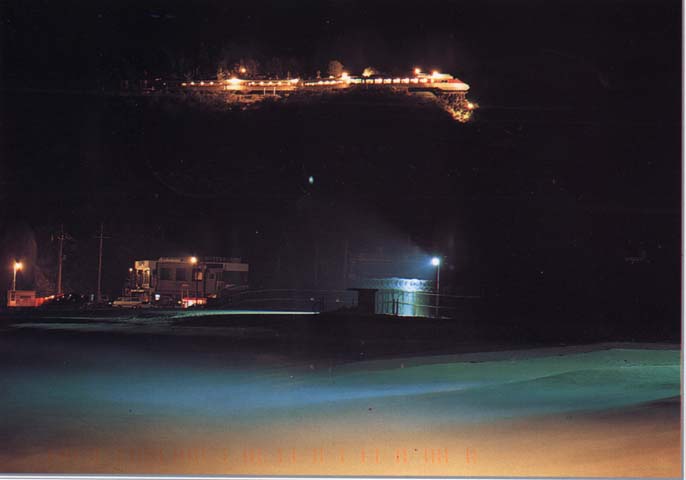
Had a great day yesterday. The
weather
was sunny and warm, and I spent the day with my friend TJ. We had lunch at Kangnung University,
and she taught me to play a game similar to nine man morris. Then her husband picked us up and
we went to a sculpture park (the train in this
picture
is actually part of the park), and to Jong Dong Jin Beach right below the park to see the
Millennium Hourglass.
The train runs from Kangnung to Jong Dong Jin. On the way home, we stopped to see a captured
North Korean submarine. It was fenced off, but the guard let me look over the fence. I wasn't
allowed to take any pictures, though.
18 April:
We've been having
forest fires
out here -- sort of makes me feel like I live in California. The winds
were so high that at first they couldn't fight the fires, but things have settled down and we've had
some rain, so it seems to be all over. Two people died and 800 or so are homeless.
We were lucky. The fire never came near this side of town, but Mrs. Kim's relatives came over
about 4:00am when their house caught fire. They were lucky too, though; they lost one storage
room, but the house was OK.
Now everyone's throwing fits because the government didn't prevent the fires. They have awfully
high expectations of their government. Who could have known?
I don't know if I'll be coming home with more grey hairs or fewer. When I see myself in the mirror
(the elevator here has a huge mirror in it), I seem to have more and more, but the kids in one of
my classes are fascinated by them and keep sneaking up behind me and pulling them out. Maybe
I'll just end up bald.
I had a nice weekend; shopping on Saturday. Cleveland's West Side Market is nothing compared
to the outdoor market here. It's a shame I don't have a place of my own, so I could try buying food.
Right now I just look.
Sunday I went to
Kyongpo Beach with my friend TJ. We rode on one of the
amusement park rides (first and list time for me), played on the beach,
had lunch, and rode bikes around Kyongpo Lake. All in all, a very nice day.
TJ is moving to Seoul this Saturday, but said she'd be in Kangnung on the weekends. Christina is
also leaving. She's already finished work at the school, and is spending most of her time getting
ready for her wedding. She gets married in May, and will move to Suchon on the west coast after
that.
20 April:
I've finally found some evidence of textile work. There's a fiber artist who has a cafe outside of Seoul,
and she's having a Magnolia Festival this Saturday. As part of the festival, there's a natural
dyeing workshop. My goal, of course, is to take the workshop, but we'll see if that happens
or not.
I haven't found anyone to go with me, and while the article gives directions on how to get there by
subway and bus from Seoul (I still have to get to Seoul first), it says you're much better off having
someone with you who speaks Korean to try to get there.
In addition, only 20 people can participate, and you need reservations, and I don't have a
reservation yet.
Apparently, this woman does dyeing and traditional knotting.
I figure if I blow it this Saturday and don't get out there, maybe I can go another day, and she'll
probably have more time to talk then anyhow (assuming I can talk to her). Neither Christina,
Mrs. Lee, nor Mrs. Kim can go. I've asked Annie, who's hesitant, but checking with a friend.
I might end up trying to go myself, but I worry then about getting there on time. People here
seem very hesitant to go someplace they don't know.
25 April:
I've finally had a fiber contact! There was an article in the Korea Herald about the restaurant Domwon
and its Magnolia Festival. The owner of Domwon is a fiber artist and was offering a public dyeing
session. So of course I had to go. I tried to find someone to go with me, for interpretation
as much as anything else, but everyone said it would be much too difficult. "If you
live in Seoul, maybe," they all said, "but from Kangnung it would be impossible." So I set off to do it
by myself.
It made me think about the fortune-teller I saw at Kyongpo Beach
[On this page
is a bit of information on fortune-telling, or chombok, in Korea - ed].
He said I had the spirit of a man in the body of a woman, and I expect that's true by Korean
standards -- although I'm sure it comes from being American more than anything else.
Anyhow, I caught the bus from Kangnung to Seoul at 7 am. It took about 4 hours to get there, on
roads (these were expressways, mind you) that would give West Virginia back roads a run for their
money in terms of twists and curves.
The buses are pretty comfortable, with a fair bit of legroom. There were even a few stretches that
were straight enough that I could knit a little.
When I got to Seoul, the next step was to find the subway. The subway station was conveniently
located right across the street from the express bus station, and even better, it turned out to be the
very station I was supposed to take the subway to. So I was able to bypass the subway
altogether.
Next step was to catch bus 133-1 to Toichon. So I walked around the building until I saw a bus stop,
which had several busses lined up. None of them was the right number, so I asked one of the drivers
where to catch #133-1. He was directing me around the corner when a passerby (they always seem
to come along when I need them) asked where I was going. I showed him the article (it got a lot of
use over the weekend) and he talked to the bus driver, and then said that bus went to Toichon. So
I climbed on and off we went.
It was about 30 or 45 minutes to Toichon, and the driver said I would have to change busses there.
When I got off and he had turned the bus around, he also got off and led me to a rice cake shop
and talked to the people there. They invited me in to sit down. I was glad, because it was getting
cold and rainy, and I had forgotten my umbrella (it wasn't raining when I left Kangnung). I figured
they would send me out when the right bus came along. Well, they did send me out, but it was
when a taxi came along. There was another lady also going to Damwon, and we shared the cab.
She shared her umbrella with me from the cab into the restaurant, too.
I made better time than I'd expected. I had worried about getting there by 2, and we made it there
around noon. So we had lunch together, and talked what little we could talk. She showed me a
letter she had gotten from Damwon talking about the Magnolia Festival, and I showed her my article,
and we compared the Korean and the English. She gave me her card (this is very common in Korea,
but I have no cards to give in return). Her name is Kim Bo-Kan -- that much on the card is in English.
She lives in Seoul -- that much is in Korean. The rest is in Chinese. Not only could I not read it, but
nobody at the institute was able to read it all to me.
All they could get was that she's a singer. She was very elegant and very nice. She's 74, and
graduated high school in 1947, just 2 years after the end of the Japanese occupation of Korea.
So all through school she was forced to study Japanese as a second language. She has 3
grandchildren.
She talked a lot more than that, and unfortunately I understood very little of it. It made me wonder
if the people I talk to understand as little of what I say.
We admired the magnolia blossoms out the windows on one side of the room,and the raindrops
coming off the thatch roof and falling into the lily pond outside the window by our table.
Lunch was very nice, but expensive. Damwon is a place where you pay for atmosphere and
presentation and quality of food, but not for quantity -- just the opposite of the other Korean
restaurants I've visited. Lunch was Egyptian -- the chef had come to prepare it the day before,
and he was coming back that night to do dinner. He was the head chef of the Egyptian Embassy,
and was coming there especially for the Magnolia Festival.
After lunch, we had magnolia tea. It was kind of funny -- two huge magnolia flowers carefully laid
side by side in this tiny teapot. After they'd brewed a couple of minutes, our server (a writer) poured
the tea into a small bowl with a bit of a pitcher-lip on one side and added more hot water to the flowers,
and then poured from the bowl into our cups. The tea was interesting; more of an aftertaste than a taste,
hard to describe. Not enough flavor to drink much or often, but fine for once a year at a festival. I
had no idea you could drink magnolias.
After 2:00 we climbed up the hill to the owner's house for the dyeing. Her name is Yu Bong-hee,
but everyone just called her Sensayng-nim, or teacher. I guess that's standard in Korea too, to use
someone's title rather than name. At the institute and here at home, I'm just called "teacher" most of
the time. It gets confusing at the institute because there are several teachers there, and when a
student says "sensayng-nim," I'm not sure whether he or she means me.
The dyeing session was a very basic make-it-and-take-it thing for people who have never dyed
before. The dyebaths were made up in advance, and there were 4 colors to choose from: bright
yellow, sage green, brown, and sort of a mauve-purple. I liked the green color a lot, but so many
people wanted that color that teacher looked a little worried, so I went for the purple. I wrote down
the Korean names of the dyeplants, but wasn't able to find translations for them in the dictionary.
The purple and yellow were wood, the brown was leaves, and I'm not sure about the green.
The Korean method is to wet the fabric first (we used handmade Korean silk -- I'll have to find out
where it's made and make a field trip). Then it's put into the dyebath at about 30-40 deg C, and
moved around constantly while it cooks. We wore rubber gloves and used our hands. Then after a
while it's rinsed, and then put back into the dyepot. One lady told us that teacher said this should be
done at least 6 times, but they stopped me after three times. Then we rinsed it several times (it never
did rinse clear -- just like when we're dyeing at home). Then the purple got soaked in fabric softer
[? Not sure of this word. -ed] before being rinsed again, and I ironed it dry. I couldn't see any
difference in the color between the first time in the dyebath and the later times. I should experiment
some time with 3 fabrics -- do one once, one 3 times, and one 6 times to see if there is a
difference after it's dry.
My piece ended up with a few brown streaks in it, and teacher said "chen chen hi," which means
slowly. So I assume she thought I didn't swish it around fast enough in the dyepot. But it turned out
that it was from when I ironed it dry -- some previous ones had bled onto the cloth on the ironing
board, and then that transferred onto my fabric. I don't mind; it adds a little interest.
Teacher has a student there, and I talked to her some, and showed her my drop spindle, cochineal-dyed
wool, and current knitting project. She was very excited, and took me into the house to show me
some of teacher's work, which is dyeing silk with natural dyes and making traditional knotted tassels out
of what's called maedup. She also showed me a book on maedup which had pictures of some of
teacher's work. Then she took me to talk to teacher. I showed teacher my projects, and a copy of
the magazine, Shuttle, Spindle and Dyepot I'd brought. I told her many Americans do these
things, and we know some Japanese textile techniques, but nothing Korean; so I wanted to learn
about Korean textiles. She said I could visit any time and learn.
27 April:
I wanted to let you know again that your Easter baskets were very well received [I sent baskets
for Margaret and 4 of her friends - ed.] ... Christina's parents were intrigued by the different
candies (malted milk eggs, marshmallow peeps, and jellybeans are unknown here, and chocolate
is available but they don't do things like chocolate eggs or chocolate bunnies). They said that
America has many strange and wonderful things. I told her that we in America felt the same way
about Korea.
Mrs. Lee kept hers hidden until Easter Sunday (I gave it to her Friday) so she could surprise her
three daughters with it. The oldest two, Janet and Jean, were born in America, although Jean was
still a baby when they came to Korea. But Janet remembered the different candies, and had a
wonderful time with the basket.
It looks like the apartment might happen after all. [Margaret's contract promises housing, either
an apartment or a house shared with others. When she arrived in February, she was given a room
in Mrs. Kim's apartment -- not such a bad arrangement, as it gave her a chance to get her
bearings with plenty of help. But now she feels she needs her own space, in part so she'll be forced
to learn more about getting on in Kangnung. -ed] Somebody Mrs. Kim knows has a tenant moving
out in May, so she's going to look at the place. I'm trying not to develop any expectations ...
I keep trying to picture it as a dark, dreary, tiny, smelly place, and just hope that it has a sink,
stove, and toilet. It's quite likely that the whole apartment won't be any bigger than Mrs. Lee's
living room -- she did say it was an efficiency.
Buddha's birthday is coming up, on May 11, and they've strung paper lanterns along a couple of
the streets in preparation for it. They look very festive. Oddly enough, though, they're at this
end of town, away from downtown or city hall or anyplace likely for a celebration. I wonder if
there's a major Buddhist temple nearby or something.
Not much else happening here. It's cold and rainy today. I was hoping that would get me out of
our morning walk, but we just went back upstairs and got our umbrellas. However, I don't feel
real inclined to wander around outside today, so I think I'll just study and knit until it's time to go
to work.